
Categories
Quick searches
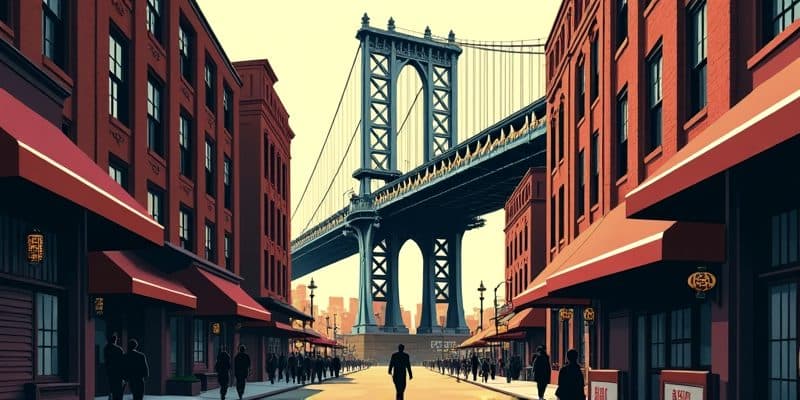
Chinatown-Two Bridges is a dense, culturally rich neighborhood with affordable housing and strong community institutions. Proximity to the Manhattan Bridge and East Broadway make it well-connected.
Chinatown-Two Bridges is a dense, culturally rich neighborhood with affordable housing and strong community institutions. Proximity to the Manhattan Bridge and East Broadway make it well-connected.
Did you know?
The Manhattan Bridge arch and colonnade at the entrance to Chinatown were modeled after the Porte Saint-Denis in Paris and completed in 1915.
Who’s your neighbor?
Housing cost
$1,296 / sq ft
Commute
Weekday mornings · leaving 7:30–9:00
- FromChinatown-Two Bridges
- ToNear Bryant Park
Family scores
Show 5 moreShow fewer
Trade-offs
Stands out
- Transit96/100
Quick weekday-morning transit to the city's main job centers
- Family-Friendly Vibe71/100
Many families with children, with homes and schools close by
To weigh
- Air & Child Health9/100
More air pollution, childhood lead or asthma ER visits than most
- Affordability12/100
Higher costs than most
Each score compares it with NYC's other residential neighborhoods.
What these scores don't measure: how a block feels on foot, what's changing on it, and whether a particular school suits your child. Walk it at school drop-off time, and check the zoned school for the exact address before you sign a lease.
Your family’s read
How does Chinatown-Two Bridges fit your family?
An agentic read of this neighborhood — including safety and cost of living — tailored to your priorities, family size, budget, and commute.
Analyze for My FamilySchools & early education
Schools15 schools
Chinatown-Two Bridges runs a solid mix of public schools, a charter option, and a couple of privates. Early learners are covered through the Hamilton Madison House centers and Chinatown Day Care, while elementary options cluster around Catherine, Hester, and Division Streets — P.S. 124 Yung Wing and P.S. 126 Jacob August Riis anchor the lower grades. P.S. 184m Shuang Wen stands out with its dual-language Mandarin program, and older kids feed into M.S. 131 and Pace High School. For a neighborhood with relatively few families, the school landscape is surprisingly robust.
Browse all early-ed in this neighborhoodLiving here
Parks & Playgrounds9 places
Columbus Park anchors the green scene here — it's the big one where you'll find the most action on weekends. Beyond that, there's a solid spread of smaller playgrounds scattered through the neighborhood: Alfred E. Smith Playground near the bridge, Coleman Playground up toward Little Italy, and a few tucked into Sara D. Roosevelt Park. It's not a park-heavy area in terms of total acreage, but the playground density is decent for a neighborhood where most families are renters and kids make up a smaller slice of the population.
10 playgrounds within a 10-min walk
Nearest large park: Prospect Park · ~79 min walk (3 mi)
Transportation30 stops
The F line at East Broadway is your lone subway option, but it's a workhorse — drops you right into the neighborhood's heart with a direct shot to Midtown and the east side. Bus coverage is where this area really shines: Allen Street, Bowery, and Madison Street keep you moving north-south, while routes along East Broadway and Pike get you across to the bridges. You're car-free by choice here, not by sacrifice.
Restaurants92 places
This is a deep bench of Chinese eats — dim sum parlors, Szechuan spicy, Cantonese Classics, and a few solid vegetarian options all within a few blocks. The hot pot and noodle spots pull crowds on cold nights, while a handful of newer arrivals (Bar Belly, Dimes, JaJaJa) add some Plant-based and contemporary flair for the date-night crowd. Delis and bakeries are thin on the ground, but there's decent takeout density if you're grabbing and going.
Groceries26 places
Chinatown-Two Bridges delivers a deep bench of grocery options, with CTown and Met Fresh anchoring a cluster of Chinese supermarkets along E Broadway, Bayard Street, and Grand Street. The density here means the weekly shop is entirely walkable—no car required. Beyond the Asian grocers, you'll find a few conventional options, though the specialty produce and seafood scenes are the real strength. Families doing a big shop will find everything within a few blocks.
Coffee Shops28 places
Down here it's less about the third-wave pour-over ritual and more about the grab-and-go bakery run or the bubble tea detour. There's a deep bench of Asian bakeries and tea shops along Grand, Bayard, and Canal — places where coffee is often part of a pastry or boba order rather than the main event. If you need a chain fix, there's a Dunkin' near Rutgers. Otherwise, it's the local spots doing the heavy lifting.
Things to Do31 places
Chinatown-Two Bridges delivers a surprisingly deep bench of martial arts schools — traditional styles like Hung Ga, Eagle Claw, and Tai Chi are woven into the neighborhood's fabric alongside solid sports options. Basketball courts, soccer fields, and the East River Esplanade keep active families moving, while a handful of dance studios, music programs, and tutoring centers round things out. It's not extensive, but what exists skews toward authentic, community-rooted programming.
Daycare & informal care
Chinatown-Two Bridges runs heavy on universal Pre-K — every one of the 13 listings is a Pre-K site, with no standalone daycares in the mix. That means families are mostly looking at DOE-funded slots at local elementary schools and community centers, which is great for cost but leaves traditional daycare hours pretty thin. Morning drop-off can get logistically tight, especially around Henry Street and Division Street where a few sites cluster together, so mapping your route in advance helps.
Family Resources11 places
Chatham Square Library anchors the civic life here as the neighborhood's only public library — a small but steady resource for families who need it. The playground scene is surprisingly deep, with Coleman Playground near the south end and Columbus Park pulling double duty as both green space and community hub. Three seasonal farmers markets — at Gouverneur Health and Two Bridges — add a nice layer of fresh produce access, though year-round grocery options remain thin in this corner of Lower Manhattan.
Healthcare27 places
Gouverneur Diagnostic & Treatment Center anchors the healthcare scene on Madison Street, with a few other hospital-level facilities scattered around — La Guardia Hospital on Montgomery and a couple of Lower Eastside Service Center locations on East Broadway. Pediatricians are thin on the ground, with just a handful of options clustered around Elizabeth Street and Madison. Urgent care is the real gap — there's essentially one spot on Bayard Street for anything that can't wait. But dentists? There's a deep bench here, with over a dozen practices across Canal Street, Bowery, and Mott Street.
Compare with nearby neighborhoods
Best schools in Chinatown-Two Bridges
Schools in Chinatown-Two Bridges
15
- Emma Lazarus High School
- Jacob Riis School
- M.S. 131
- Manhattan Charter School II
- MESIVTA TIFERETH JERUSALEM
- Orchard Collegiate Academy
- P.S. 001 Alfred E. Smith
- P.S. 002 Meyer London
- P.S. 042 Benjamin Altman
- P.S. 124 Yung Wing
- P.S. 126 Jacob August Riis
- P.S. 184m Shuang Wen
- Pace High School
- TRANSFIGURATION SCHOOL
- University Neighborhood Middle School
Early education in Chinatown-Two Bridges
21
- 60 CATHERINE STREET
- 77 MARKET STREET
- CHINATOWN DAY CARE CENTER
- Chinatown Day Care Center, Inc.
- Education Alliance - East Broadway
- Hamilton Madison House Earlylearn Center 2
- Hamilton Madison House Earlylearn Center 4
- Hamilton Madison House Earlylearn Center 5
- HAMILTON-MADISON HOUSE, INC. AT 253 SOUTH STREET
- MANNY CANTOR CENTER
- MESIVTA TIFERETH JERUSALEM
- P.S. 001 Alfred E. Smith
- P.S. 002 Meyer London
- P.S. 042 Benjamin Altman
- P.S. 124 YUNG WING
- P.S. 126 Jacob August Riis
- P.S. 184m Shuang Wen
- TRANSFIGURATION SCHOOL
- TRANSFIGURATION SCHOOL
- Victoria Children's Center
- VICTORIA CHILDREN'S CENTER, INC
Frequently Asked Questions
- Is Chinatown-Two Bridges a good neighborhood for families?
- Chinatown-Two Bridges scores 45/100 for families on Motley — near the middle of the pack citywide. The Family Fit score blends six parts: how many families live there, schools, affordability, weekday-morning transit time to job centers, safety, and air quality and child health.
- What are the pros and cons of Chinatown-Two Bridges for families?
- For families, Chinatown-Two Bridges stands out for quick weekday-morning transit to the city's main job centers, and many families with children, with homes and schools close by. What to weigh: more air pollution, childhood lead or asthma ER visits than most, and higher costs than most. Each score compares it with NYC's other residential neighborhoods. They don't measure how a block feels on foot or whether a particular school suits your child, so walk it before you decide.
- Is Chinatown-Two Bridges safe?
- Chinatown-Two Bridges scores 53/100 on safety — near the middle of the pack citywide. We build the score from NYPD crime complaints, pedestrian and cyclist injuries, and serious (Class C) housing violations, each counted per 1,000 residents.
- How are the schools in Chinatown-Two Bridges?
- Chinatown-Two Bridges has 15 schools mapped inside its boundary and scores 42/100 for schools — near the middle of the pack citywide.
- How do middle and high school admissions work from Chinatown-Two Bridges?
- Middle school: families in Chinatown-Two Bridges apply in 5th grade through the citywide middle school application. District 2's 36 middle school programs admit by method: 21 screened, 6 unscreened, 5 zoned and 4 charter lottery. District 1's 16 middle school programs admit by method: 9 screened, 6 unscreened and 1 charter lottery. High school: one citywide application in 8th grade lets a family rank programs anywhere in the city, and the eight specialized high schools admit on the SHSAT alone.
- Is Chinatown-Two Bridges affordable?
- Chinatown-Two Bridges scores 12/100 for affordability on Motley — among the pricier parts of the city.
- Which borough is Chinatown-Two Bridges in?
- Chinatown-Two Bridges is a neighborhood in Manhattan, New York City.
Want personalized insights for your family?
Sign in to get an agentic neighborhood analysis — including safety and cost of living — tailored to your priorities, family size, budget, and commute.